Friday, October 3, 2014

yewSOL

To work with solar panels, you have to sit outside.
Prototyping electronics, one rarely gets to work outside. Testing solar panels, however, is a good chance to get out, at least for a little bit.

What I have are a hundred pieces of six volt, hundred milliampere panels. I am using them to charge two varta three-packs of nickel metal hydride cells, totalling a normative voltage of seven point two. So, of course I made a switching boost circuit, comprising an n-channel mosfet that momentarily pulls an inductor to ground, but when current develops through the inductor to positive, a capacitive coupling to pnp turns the mosfet off. Thus the inductor circuit oscillates at its ideal, between 8000 to 320000, depending on load. I initially wasted a lot of time with so-called "joule thieves," but these were the least efficient, compared to a snappy mosfet action plus tightly factory bundled inductor.

So, my only modification to check outside with the panel was the hypothesis that, when the battery was completely discharged, the switcher should be inhibited, yielding pure DC through the inductor and diode. So I made a simple PNP switch comparing panel voltage to battery voltage, to control the switcher bias. I discharged a battery pack completely, and attached it to the circuit. DC flowed and switcher was off, success. However, I noted that the efficiency was only about 150% better, and most importantly, the NiMH only stayed below 6 volts for a very short period of time. Thus, I'm not going to add this mod, because it really doesn't help. I've found that a NiMH acts like a capacitor when discharged, so it charges up really fast. It is only when it is up at its voltage, that injecting more current is what re-alchemizes its chemistry. Also there is various literature pointing to the aggressive pulsing of a switcher actually helps keep the chemistry good in a battery. The most important thing about this switcher is that the panel can be small; it is matched to the wattage dimensions of the battery, and that it works even in room light, so it is always adding charge.

I'll talk about this later, but there is a deep thesis in solar powered electronic music. The idea is that you should be playing during the day while it charges, and use the battery powered sounder at night, around the campfire, to scare away ghosts, or in a cave, to hear the galleries and depths.

Friday, September 12, 2014

Compartments, Chaos-Pack, Flambeau-Pack

Flambeau. That word incites to organize, and celebrate organization. Recently, I purchased two large, 24 compartment Flambeau boxes, to put my capacitor collection into spreadsheet-like compartments. The reason I suddenly have a lot of capacitors, is because I started a new project, called Tocante, based on the industrial values, called preferred numbers, used to grade components, and the musical tuning they generate when used in oscillators. There is a musicology here, and I defer to a separate post to use spreadsheets and graphs to show the uniqueness of this tuning. This post is about organizers!

Organization by Talenti: too deep for electronic components, much better for gelato.

I found these deep Flambeaus in the dumpster of the materials institute, Johns Hopkins University. They were labeled "Piyush" and contained metals embedded in epoxy. I have since used them for the bulk of my components storage. Chaos-pack works here, because the components are quickly used and in bulk, so there's almost no point to sorting them out.

Another deep and long Flambeau with Chaos-Pack

Now this milky Flambeau, since it has 24 compartments, suits a high degree of organization, for components graded in preferred numbers. Serendipitously, electronic components are graded in multiples of three, according to the E3, E6, or E12 scale, so you can see "103" and "102" are in the same column. This box makes it easy to see magic numbers and the composition of scales more clearly, plus it has room for some spare inductors and diodes. Bigger capacitors in the back, and smaller in the front: a musical scale that goes from low to high. The reason it starts on 223 and ends on 471 is because the primary scale is from 103 to 102 and the extensions provide alternative pitch clusters by doubling or halving their value; capacitors in parallel doubles, series halves.

This is an organizer I inherited from my dad; it held locks, nuts, bolts, washers, gaskets, and cotter pins. Now it holds the 10 colors of "Johnson Banana Plug" as well as a few other chaos-packed drawers of components.

Storage by cardboard box: for counterpoint here is part of the wood storehouse.

Sunday, September 7, 2014

M : CcCCcccCCC : M

The title of this post relates to Marx's most basic theory of dissing the bourgeoisie: by pointing out that they trade money for commodities, and leverage up the value of those same commodities to make more money.  This is in dialectic, according to Marx, to the other way around, CMC, which is "what farmers do," trade a commodity for money and back again for another commodity, like a dental appointment.  He says that, if anything is leveraged from CMC, it is only by mistake.  I am at a point in my life where I beg to differ, or at least to argue for a more sophisticated treatment.  Phirst of all, the CMC should not be discounted as a leverage tool, because commodities can have immensely more value based on the situation they are received in; a dental appointment could be crucial compared to excess stockpiles of wheat.  You could say that CC, or bartering is the most natural and profitable, but he leaves this out.  I would even posit that most 21st century cookoos think in termes of CKC, the exchange of commodities for karma, and then back to commodities- just think about how often you analyze your life this way and you will find that it happens, or is made to happen resonantly. 

Back to MCM.  Marx thinks of it in only a one-dimensional, most dissingly way, where he thinks of the commodity in the middle as completely fixed.  I see it as a liquid, or a cloud of many disparate things, dare I say a Mille Plateux.  Or a body without organs; a becoming wolf; a nomadic monad, a wine-drunk philosopher pissing.  I have piles of wood purchased from an old man Dave in Massachussetts, a real artisan who sold me catalpha, mulberry and sassafras. In addition, my stockpile includes old leaden cathode ray tubes, wound transformers, enamel wire, BC556 NPN transistors, strange circuit boards layed out like a pagan ceremony, not to mention pagan ceremonies themselves.  It is this cloud of commodities, the CcCCcccCCC, that is the ham in my money-bread sandwich.  So why feel guilty in synthesizing a lever?

Recently, I have had to do electronics component buying apart from the regular channels Mouser, my "white goods" solution.  You know this is so racializing, and it gets more so.  Most of it is a paranoia of the Chinese, so little understood and so popular these days.  In fact I do a lot of business back and forth.  We all know most chips come from there even if sold on Mouser's pearly white pages.  Everytime I get a hot new synth board back from the plant in shenzheng, I get hot boxed by my Beijing affiliate MengQi who gets the board straightaway.  Turns out I've had to make four large purchases from four completely different outlets in different countries.  The following list-story is characterizing each, with a slightly obfuscated name, to highlight some of the humor and spice of my business day:
  • Stella Gressive, despite her name, she is very polite, although I can't tell where she is from.  Her company, Fartle, makes really nice Nickel Metal Hydride rechargeable battery packs.  They are out of Germany, although they deal with me out of their office in Persnickety, upstate NY.  She is all about invoices; me and Steve Kornico have to constantly update a google spreadsheet to "make it official" before purchasing the batteries.  Invoices are required for customs and for trade agreements; they don't want people to buy their batteries and then resell them at a jack-up, i.e. MCM bourgeouis; Fartle is thus communist.  OEMs, or Original Equipment Manufacturers, however, are M:CcccCCCcc:M's because they take many disparate commodities, synthesize a new "white good" or synthesizer, and leverage it for profit.  Steve Kornico and I had to prove we were such a communist-friendly company by talking with our capitalist lawyer and producing another google-friendly word doc.  To recap, Stella Gressive wanted a word doc and an excel spreadsheet.
  • Shirley Tang, in Hong Kong, handled a recent order of metal potentiometers.  They could be gray market, but only because they are beautiful gray metal.  They are made in Japan, shipped to Hong Kong, and stockpiled at a "holdings company".  Holdings Companies are just that, like a warehouse, but in Hong Kong, there is also an opiate tinge to all business.  In fact, I have two pieces of evidence to support this.  One, they advertise "opium of the Chinese IC" on their website, meaning their transistors are addictive plus cause blurry psychadelia.  Two, in sealing the deal they sent many "Chinese checker" pix of the product to "make sure" I'm getting the product, and I noticed the tape around the box is encrusted with resinous roaches.  I connected with Shirley's holding company through AliBaba, apparently a silk road/abu dubai reference; the worm is the spice.
  • Mooney Tai, the other Chinese connection, handles solar panels.  Mooney's main feature is the power of pure return/complaint system.  They have a warehouse full of millions of different sizes and ratings of small solar panels meant for garden sculpture.  Some are real hazy, half baked affairs, but the one I had tested off of ebay and spec'd out was really nice, waterproof.  This is not the one they sent me, but a real piece of maple syrup that I am returning tomorrow with a note on Andrew Jackson, saying I want a 60xninety mm instead of 135xseventy5mm, and I want it MaShang, or "on a horse", i.e. ASAP.  I suspect they wanted me to eat their inferior product but I plan to complain and return until the cycle is complete.
  • Finally, we get to Kenneth, at DRP, in Iowa.  He has been so nice the whole time to me.  The Chinese businessmen are very quick and comprehensive in their emails, as if their life depended on it, but Kenneth is laid back, like a farmboy who makes guitar pedals.  I am still waiting on the payment link for knobs he said he would send to me; not like the Chinese businesses who try to do the whole deal in one day.  Kenneth spends time to talk with me on the phone, I think he enjoys putting the phone to his ear and laying me to rest.  Not that he's better, this is just the world you dive into when you leave the safe machined pages of Mouser, a juxtaposed realm of ultra-fast industrial zones and small town dial-up consultancies.

Sunday, August 31, 2014

Wednesday, June 25, 2014

A Survey of Modular Folk, Summer 2014

This summer, with funding from Wesleyan University graduate program in Experimental Music, I embarked on a journey to characterize the modular synthesize industry.  To do this, I participated in two events: the Tokyo Festival of Modular Synthesizers; and Control Voltage Fair, in New York.

I had long had a bitter taste from such fairs, because of poor sales at the event, and also a certain loudness in the bazaar that is due to competing demonstrators.  For this reason, I would only go with a radical, experimental mentality, almost performative.  Also, due to the scholarly funding, I could adopt a researcher's attitude towards the technology, akin to Georgina Born's ethnography of IRCAM.  Thus, my tack and proposal was to research the current culture of modular synthesizers, through the aesthetics of booth (beeth?) presentations, and any techno-shamanic folklore passed around by participants at these events.

Part of my strategy at these events, was to be aloof to the competitive sales atmosphere, by trying to present the radical ideas that my business has been known for over the years.  Paper circuits as experimental prototype formed the throat of this thrust.  I have been working for several months on a new line of euro-rack modules, and since this is exactly this format that predominates at modular fairs, I focused on a paper display for the new pieces.

Euro-rack is a standardized format for modular synthesis, using mono-mini plugs and cords, a "4U" height, and most importantly, a bi-polar power supply of +12 and -12 volts DC.  My other two businesses, Ciat-Lonbarde and Shbobo, are based on uni-polar power supplies of 9 volts and 3.3 volts respectively; the 9 volts is for analog from a single battery or wallwart, and 3.3 volts is a USB digital device.  In porting concepts over to the euro-rack specification, I decided to create a new business, named "Ieaskul F. Mobenthey".  All these names come from a single drawing from 2002, titled "Stores of the Mall", that I hope to display proudly on the release of the new modules.  It is really a format for a bantam business; the Stores of the Mall is a 'tent' that generates new sub-stores, rather than trying to maintain a single aesthetic at the locus of a singular business.

To manifest "Stores of the Mall" in physical form, I decided to build some conceptual synthesizers out of cardboard boxes and extremely fine, Japanese "washi" paper, provided by my mother-in-law at her business, Tapiro Creative, LLC.  Each box represents a separate business; Ciat-Lonbarde and Shbobo are finely lettered signage on wonderfully textured earth-tones.  However, it is the box for Ieaskul F. Mobenthy that received the most attention, because it is the most hypothetical at the moment.  I used bright green washi to wrap a box about the size of a small euro-rack cabinet.  Then I rendered the current working designs of Ieaskul's designs, and printed them on cards that were affixed to the front of the box, thus making a virtual, paper modular for display at my booth.  Also on display was a working paper circuit prototype of the innards of one of these designs, further enhancing the radical paper motif.

Stores of the Mall: the radical washi synth
On to the events!  First was the Tokyo Festival of Modular, on June 7 and 8.  The venue, Super Deluxe, is a mid-size basement club serving cold beer and snacks.  Having no raised stage, the "headliners" tables spilled out into the space, which was littered with many black-draped merchandise tables.  Of course, there were many local Japanese manufacturers, that I had never encountered before, making some very enigmatic equipment.  Also, a good sampling of American and a few European synth makers were there.

Tokyo Festival of Modular
Of course, the name "Festival of Modular" implies that it will feature modules, most probably in the euro-rack format.  However, there were a few standalone type instruments, and my booth, except for its "conceptual paper eurorack" was in the minority category of handhelds and unique boxes.
Stores of the Mall @ Tokyo Festival of Modular
Kirito at the Little Bits station
The sound was overpowering, extremely loud cacophony of mixed sequences and other blips and bloops.  I regret that I had not recorded the sound, for the pain it had caused my ears may have become bliss when re-listening at low volumes on a home stereo.  There, I could analyze it and perhaps enjoy it like an atmosphere of ambient frogs on a hot summer night.

Each station, representing a store or manufacturer or other vendor of synthesizer modularity, would normally be setting up some sort of "jam" consisting of sequenced pulses.  The use of sequencer modules is predominant.  Some of the more interesting stations, however, focused on idiosyncratic, non-linear and un-striated sound assemblages.  I chose to focus my attention on the first island, a grouping of four stations, three from America and one from Russia.

Scott Jaeger
Scott is a resident of Seattle, where he runs "The Harvestman," a series of euro-rack designs that have interesting names and function.  For example, the "Piston Honda" is a sort of 3-dimensional wavetable synthesizer, but its name suggests more mundane origins; did Scott's Honda Civic inspire a sophisticated synthesis for its emulation?  He said yes, but we didn't go into details.  Scott spent some time in graduate school, where he designed and implemented these modules.

Another research area was an esoteric Soviet synthesizer, the Polivoks.  Scott worked with the designer Vladimir Kuzmin to bring back the "bizarre, agressive, and entirely unique character" in euro-rack format.  The filter, for example, uses no external capacitors, and relies solely on the non-linear and contingent capacitance inside the silicon components.  It looks like Scott is skilled at compartmentalizing his business into unique sub-groups with strong identities.

Each of the participants from afar, due to baggage restrictions, brought only a small suitcase worth of modules, about one typical segment of a euro-rack system.  Thus they chose only the most important modules, and it is a comparative analysis of each distillation that proved most insightful.  Harvestman's aesthetic is uniform in color, with orange knobbage over an aluminum background.  However, there is a certain pragmatism in the layout, reflecting the idiosyncratic nature of the modules themselves.

All of Harvestman's aluminum face-plates are manufactured in Cincinnati.  To some collectors of euro-rack modules, a consistent aluminum appearance is very important, harkening back to the earliest days of Doepfers.  Since I am considering using other materials in face-plates, I always ask makers' opinions on material.  Scott finds the company in Cincinnati very convenient and cheap, but says that he personally has no problem with alternative materials.   There are about three reasons to use alternative materials in the face-plate: simply to introduce a new color and instant recognition to one's brand; because aluminum is conductive, some touch sensitive surfaces need to be implemented as circuit boards; circuit boards as a material are lighter, and I would say more immanent in that the circuit is its own container...  

For more thoughts on manufacturing, I looked across the table to another resident of the Pacific Northwest, this time from Portland:

Josh Holley

Josh is president of Malekko Heavy Industry, which makes some guitar pedals, and many euro-rack modules.  Josh is skilled at networking with other designers, to license and adapt modules for a maximum variety under one roof.  In fact, his main business now seems to be the Dark Space manufacturing center, that offers its services to all synthesizer designers to assemble their product, and even ship it for them.  Thus skills in integration are what makes his business tick.

A glance at the Malekko distillation yields a sense of uniformity, whilst representing many different lines.  Each different line, or sub-brand of Malekko, is differentiated by subtle appearances of changing fonts, knob size, or most importantly, layout decisions.  A foremost example is the layout of Wiard modules, which segregate knobs on top from patch points below, whereas many other designers choose to integrate knobs and jacks, so that functionality flows smoothly from manual control to patching.

Cyrus Makarechian
Another integrator, Cyrus, runs the new Muffwiggler store, in Los Angeles.  He shares business duties with Mike McGrath, who created the namesake of the store, the Muffwiggler forum.  This forum is devoted to analog synthesizers and synthesis in general, and it remains one of the most heavily trodden places to discuss such topics on the internet.  It was a natural outgrowth to start an internet store, that showcases all the mainstream modules, but according to Cyrus, it also sells the more idiosyncratic and esoteric modules, found by combing through all the accumulated forum discussions.

A look at Cyrus' suitcase sized rack shows many different kinds of modules, constructed of different materials (clear plastic, circuit board, as well as traditional aluminum), some with enigmatically sparse legend and thus an intuitive demand on performer.  In representing a divers forum of synthesynthesists, a most pragmatic look is achieved, and also the sense that Cyrus may find sublime new connections due to the overlapping philosophies.

For those makers who chose not to build euro-rack modules, there are more options, in enclosure shape and size, besides those already mentioned choice of faceplate material, font, and other legend features.  Here's a synth maker to watch out for, from Peru, Atomosynth:

Alfredo Aliaga
Alfredo's modules can actually fit in euro-rack, but he chooses to display them as standalone instruments.  The combination of smoked plexiglass, clean etched lines, and sometimes some lime green plastic, make them quite unique.  It's like my son, he is addicted to fishing, and we go to the fishing tackle store.  Bass is this ultimate fish because it angrily snaps at colorful plastic jelly and ASMR producing lures, lures that ultimately serve the fisherman a dose of addictive candy unboxing as well.  Go Alfredo!

My own brand is marked by a pronounced lack of candy, although there is good wood, sauced generously with tung oil.  However, I do not have a business card, and although some triangular poster cards still exist from previous days, I was lacking any paraphernalia, so when constructing washi paper circuits at Tapiro Creative, LLC, I re-purposed some fancy calligraphy cards from the trash.  My mother-in-law had experimented with layout of a phrase, "learning the sound of rain," and although she wished the world to not see her failed calligraphy, i found the black brush strokes fertile ground for ballpoint insertion of circuit diagrams:

business card for ciat-lonbarde

Here's some more happenings at Tokyo Festival of Modular

5G, a Tokyo Modular store, brought a wall!
Hikari, nice vintage 50s looking cases
I think this is "JMT," a Japanese Analog/Noise Booth
My wife and son jamming little bits n' Korg
Headliner: Keith Fullerton Whitman
A fine threesome of electronic performers...
Synth T-shirts: Merchandise about merchandise


Modular event number two was the Control Voltage Fair, held in Brooklyn, on June 21, 2014.  The specific location was Ten Eyck street, a real portal Hague of the new world, crammed in between an oily river and a bunch of Chinese merchants, it also contained many nose-rings and kindly death metalists, as well as other fuzzy burlap berets and various accordion toters...  Brooklyn, on a cool day, during a "river to river" music festival was a great place to have an open door to a dark warehouse spilling out loud modular sounds.  In all of the following pictures, note the completely different light, it being a natural, blue-sky day.  Super Deluxe in Tokyo, a basement at night, had great spot-lighting, but the warehouse in Brooklyn had no artificial lighting at all, just skylights and garage door.

old industrial Brooklyn: site of Control Voltage Fair
Speaking of loud modular sounds, having endured the cacophony of the Tokyo Festival of Modular, I had all but sworn to completely "go conceptual" and leave the amplifier off at my table of this event.  Turns out, the space was about twice as tall and half as populated with beeth, so there was a little bit more room for sound.  Thanks to Abby and Matt who offered me a K8 PA piece last minute there.  I did find the sonic environment here a little bit less aggressive, and the open garage door afforded natural light and escaped many slap echoes, also there was more of a holistic view on synthesis, with video processing and conceptual emphasis strong at the Harvestworks booth:

Brian Moran/Adam Kendall, video processing modular
I set up booth similar to the Tokyo Fest, with much paper concepts, but also a quite clearer sounding demonstration of touch-organs.  Next to me was Mark Verbos, of Verbos Electronics.  You know it's great how names work; Mark is not a loud or loquacious dude, but his Buchla adaptations do feature the verbose legend of the original.  Or at least verbose compared to my stuff and other enigma variations.  Mark was a nice guy and I enjoyed learning about his clean, professional aesthetic.  He's repaired many Buchlas, and from this he got great ideas for his own euro-rack adaptations.  Like Roman's work, the Mark's use mini-plugs solely, shunning again the structuralist impulse of banana separation.  Also the modules have a strong clean aesthetic, with the classy pin-lines of the original, but a little more strength of color contrast; he uses blocks of black ink  next to bare aluminum to help break up the monotony.  Note his brand-shirt, grey of aluminum, black of silkscreen, white accents and red knobs.  Very clean brand vision:

Mark Verbos
Control, the store in Brooklyn, is another strongly designed brand.  In fact, the co-owner Daren went to graphic design school in Iowa.  They collect all types of "mostly" euro-rack modules, and have a great showroom that you can come in and play around for hours.  To CVF they brought shirts, cards and a nice stand of all sorts of modules:

Control
Pittsburgh Modular and Make Noise had a new piece of paraphernalia: coozies:

Pittsburgh Modular
Now, Meme Antenna, I had heard about before.  I was talking with a film-maker about wooden synthesizers for sale in Japan.  I had never really sold synths there, even though we go there every year to see my wife's family.  Adachi Tomomi understood completely, and informed me that I would never sell wooden electronic instruments in Japan; he pulled out some of his own instruments, made in tupperware, and declared them more viable on the Japanese market, because they approach the cool, club-like industrial texture of powder-black metal cases.  I went to Japan to find out more about the flaw in wooden electronics.  My hypothesis was that the "ki" of wood is an ancient one, used for housing fine clothing, family relics, and of course, ancestral ghosts and natural spirits in shrine usages; electronic synthesizers are related to ballistics, communication and war.  The two morphic resonances are difficult to mix, but over the years this encasure will become easier as a process of mutual negotiation is played out.  One reason for visiting Japan was to participate in my wife's grandfather's 37th death anniversary; this is an important year for according to Shinto, he may now become part of an ancestral spirit, losing individual identity for the sake of a more powerful family entity.  Perhaps there is a similar process unfolding in materials for electronics, as wood, metal, plastic, and silicon can be blended more and more.  I saw a little bit of wood in Tokyo Festival of Modular, but it only is used to emphasize a certain vintage feel.

The film-maker I was speaking with hinted me on to Meme Antenna, a store in Brooklyn who sells the “Lio&Linn-wood+metal-," a fine walnut case for euro-rack modules.  I met the owner and had a wonderful chat with him.  The store seems to be tucked into a cute hipster/loft "mini-mall" in Bedford, judging from the tin ceiling.

Meme Antenna
What is the fate of euro-rack?  I should have gotten into it five years ago, perhaps even ten years ago, but I'm happy with staying out for so long, working with wooden synths, single-rails, powered by battery.  I did a lot of experiments with connectors other than mini-plugs and banana jacks; the best were the brass nodes, that reacted to touch connections with intuitive consequences.  I now dive into my euro-rack work with a few new modules; more on that in later posts.  Musing on all the hubbub over this format, one friend of mine postulated that it's all going to a sort of big drum machine, a steady state beat box.  I hope not, and I know that modulations are the exit from steadiness.  The website of Steady State Fate has a fine essay on this topic, about initial conditions, the butterfly effect, and attractors et al.  Ironically, it was SSF that provided the main beat of Control Voltage Fair, a two-step bass and splash that made me dance bouncing up and down.  I heard every twist of the tempo knob; unlike techno performers who keep it steady, Andrew Morelli was undaunted and moved it around up and down, and made me re-evaluate my habitual cool-boy dance bounce, and ask, what am I doing here?

an omen of the future: steady state rhythms
Apologies to any synth makers who were at these events, kindred spirits, whom I didn't cover in these pages.  There were many great ones, but this comparative survey has wound its course and I go to my pillow to rest and plan triangular oscillators and rounded chaotic integrators.

Sunday, April 13, 2014

Friendship Bracelets: Deconstructing the Triangle Wave

A Seminar at UCSB

Deconstructing the Triangle Wave

Abstract

The speaker's analog circuits explore novel uses of simple components to yield chaotic and rich electronic timbres. Using examples such as "deconstructing the triangle wave," he will explain porting these concepts to a new, digital synthesizer, the Shnth. Ensuing topics include carving a squishable case, and classic computer music in embedded systems.

Biography

Peter Blasser, designer and builder of synthesizers at ciat-lonbarde.net, practices deep consultation with clients who seek rich interactions with their electronics. The instruments manifest electronic modulations through nodes, case flexure, and radio fields. He teaches circuit design and instrument building in classes and workshops, culminating in performance or installation. Some paper circuits can be downloaded from his website, printed out, and assembled to yield sound objects. The cybernetic interface uses the subtleties of touch, through discrete components, often "woven" together geometrically, to simulate intuitive patterns and chaotic sophistication. His designs are spurred into existence to explore platonic or philosophical concepts, which then acquire a narrative as they are refined into essential analog synthesizers.

Analog Synthesis of Triangle Waves

I would first like to demonstrate an analog synthesizer, the Sidrax Organ.  Seven flexible wooden bars sense performative squish, sonifying it through seven essential triangle oscillators.  It is an amplitude modulation; the instrument is silent when un-touched, and electronic tone loudens with pressure.  There are forty-two nodes that when patched by wire or touch, connect voltage representation of said squish and the triangle waves to frequency modulation and glitch inputs, to be detailed.  The synthesynthesist learns to make a triangle oscillator very early on, however, it is durable through a wide range of modifications and enhancements.  Furthermore, it can be used as sub-component for more sophisticated assemblages.  
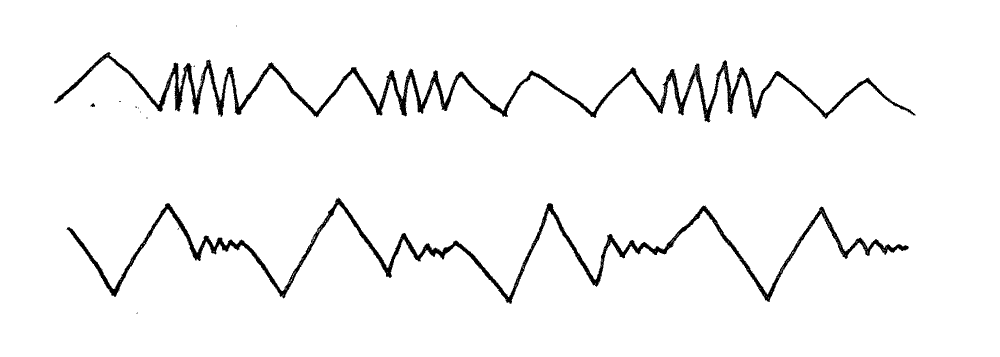
saw variations and clean triangle
The triangle wave is a sort of mechanical system that, in analog electronics, features one capacitor that charges and discharges in alternate strokes, controlled by a hysteresis mechanism that sets its bounds.  The speed at which it bounces is the usual method of modulation, and this bounce can be further split into two branches- the speed going up and that going down.  This is the source of the saw wave and various other articulations between it and the essential triangle wave, which has equal speeds up and down.

The first point I would like to make is that there are actually two ways of modulating a triangle wave- controlling its bounce as already mentioned, and also controlling its bounds.  Actually bounds modulation is practiced quite often, but not distinguished from the other way; hobbyists with the old and brutal "555" chip, when modulating, are actually controlling the top breakpoint,"threshold" of a saw-triangle amalgam. This method is shunned by the more sophisticated synthesynthesists, because it only modulates the bounds,which is an instant in time rather than the continuous modulation of bounce.  Bounds modulation is also the route to sync-lock circuits; when the modulator is faster than the carrier, it generates an integer-locked undertone series.  This is the magic key to what we will talk about later in the digital emulation of these circuits.  But for now, we have opened triangle wave oscillators to two kinds of modulation, bounds and bounce.  The two taken together offer rich ways to control the wave:
modulating bounce and bounds
A hi-fi enthusiast's reaction to the triangle wave is anxiety about infinite energy present in its sharp peaks.  This energy is theorized by fourier analysis of the "perfect" wave, concluding that a harmonic series extending to infinity is the source of the transients.  These frequencies, and thus energies, will break speaker cones of the hi-fi set.  Of course, in reality they are rolled off, but it is an interesting reaction due to the fourier-dependency of acoustic theory. 

A triangle rotated becomes square steps on a staircase; the triangle and square wave go hand in hand, for the square signal is involved in the mechanism of the hysteresis loop, which decides instantaneously to reflect the wave in opposite direction, or sign change.

When a boy sees a triangle wave, he will most likely see shark teeth; a geologist, freshly formed tectonic mountains without rounding erosion.  I like to see the tail ridges of a basilisk or iguana.
bounce is the slope or speed, bounds changes the height or depth
Listen to mylar chips-bags crackling nearby as someone eats a sandwich.  As a misophonist, I am repulsed by and attracted to these crackling and crinkling sounds made from impulses of mylar folds flipping from concave to convex.  They are an explosion across the spectrum made from sharp changes; mylar is the only plastic that generates ultrasound, and one can easily distinguish it clearly from all the other synthesized sounds in our environment.  Listen to it, especially with high pressure in one's ears, and note the difficulty of reproducing these crinkles by fourier methods; it is hard to mp3 compress a chips-bag.  I am spurred by ASMR studies to bring these sounds about for the benefit of listeners who hate sounds, so that they may love them again.  Two ways to do this:
  1. physically construct sculptural mechanisms such as coke bubbles in aluminum or solenoids that squish candy wrappers.  Note that misophonists often need a conscious target for their sound-rage, and if the same sounds are generated by a machine, the anger is diffused.
  2. electronically synthesize the chips-bag.  here is where assemblage of triangles comes to the fore.
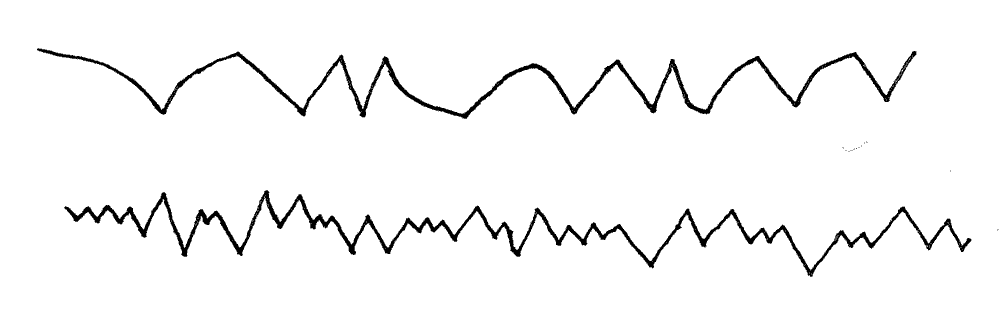
bounce and bounds modulation discloses chaos

Triangle Wave Assemblage

Now I'd like to describe a few circuits that combine triangle waves to break out the inherent possibilities of sharp peaks and modulation to make chaos, or the afore-mentioned "chips-bag".  Fourses was originally a kit to make "novel musical sounds," available from Ciat-Lonbarde.  It was inspired by the thinking detailed above, about modulating both bounce and bounds, to see what happens when oscillators bounce off of each other.  Four horses is the metaphor of the naming, but it may be easier to think of them as bouncy balls in a greased tube of their diameter plus a little breathing room so they can move smoothly but not pass each other.  Incidentally, this is the same sort of thought experiment used in particle studies to highlight how particles of the same sort are indistinguishable from each other so they may be thought of as bouncing or passing through each other.  However, these particles are distinguishable, for they have separate bounce controls for each one; traditional fm modulation of slope makes them unique operators in the experiment.  When they bounce, then, they create triangular waves of chaos in the system, to be sampled and enjoyed by all via electro-acoustic diffusion.  
fourses mentality: bouncing off of each other's contingent bounds
I am bringing Fourses back in the near future, and I would like to demonstrate how these circuits are initially prototyped on paper.  On paper circuit, that is.  I have constructed the four oscillators, and their analog switches connecting bounds to each other, with four knobs in the middle to explore the various settings of bounce that make the assemblage more or less reactive.  This instrument is also nodal, in that it has many touch points, for circuit-bending the apparatus and creating further modalities.

Nodal synthesis is not the topic of this discussion, but it is fruitful in triangle waves, because their synthesizer is a mechanism that you can "go into" to massage its inner, soft workings.  The charge capacitor and hysteresis loop are circuit bending points that correspond to the formal modulations of bounce and bounds respectively.   Another instrument that uses nodes as well as the formal modulations is the sidrax organ.  In this organ, which I demonstrated earlier, I wanted to take the modalities of fourses, generalize them, and offer gestural control via the wooden bars.  The seven oscillators are arranged in a circle, for continuous bounce modulation from one to the other, controlled by an aptly named "chaos knob".  In addition, each oscillator has two nodes, called "glitch" inputs, which rewire their bounds to refer to other oscillators, as in the fourses.  The difference is, that sidrax has a "ground state" where each triangle operates within fixed, normalized bounces, yielding a perfect, singular frequency wave.  I've found it important to have such a base state to start performance, and take it from there.

schematic of sidrax organ

Tricentric Logics for Analog Synths

Recently, I've been doing some theoretical work, stemming from the writings of Anthony Braxton.  I am inspired by his use of the word "logics," in the plural, to suggest that a multiplicity can exist in logical schemata; this notion seems to overlap somewhat with the assemblage theory of Manual de Landa, derived from the concepts of, of course, Mrz. Deleuze+Guattari and their Mille Plateaux.  In his new materialism, de Landa outlines how assemblages are generated by materials, and that there is something of a universal singularity, or over-arching diagrams that can be shared amongst assemblages.  In contrast, the unique assemblage is its own individual singularity.  That is, synths have diagrams that may disclose universalisms, while having idiosyncrasies in their resistors, transistors, and capacitors, not to mention wiring, knobbage, and modulation decisions, that make them unique.  One schematic propogated by Braxton is tricentric logics, or an overlay of musical groupings based on three symbols: the circle, triangle, and square.  I am working, in describing the Plumbutter synthesizer, to use tricentric logics to describe the immanent diagrams of analog synths, to describe the underlying mythologies of the synth chain.  For example, rounded versus sharp is the dialectic of most analog sounds; vco is the angular part, and vcf is the resonator of sinus frequencies.  
resonant excitation, or spiral if viewed in polar imaginary

If we take this point about round versus sharp, we have almost finished porting tricentric logics to analog synths.  You see, the round is the circle symbol, which literally happens if you run a resonant filter at saturation; a sine wave is one axis of a circle.  The other, angular part, all our triangle and saw waves, is the triangle symbol.  The only symbol left is the square, but we know that square waves are important in synths too; they are the pseudo-digital logics provided by 4000 series chips, as well as all the multi-stable, primitive transistor circuits. 

All this symbolization is fine and dandy, but where does it get us?  One benefit of porting diagrams, is to think and ask questions such as, if a circle resonator has an "input", as a filter, what would it mean if a triangle had an input?  Can we make a triangle wave behave like a spiral?  This question became of interest when designing a game, Mikey Walker, which we shall get to.  Basically, I needed more ways for the enemies to act when punched.  They were all resonating, and I wanted some to resonate in a triangular way.  Thus the "zwave" came about.  It is like a resonance in that it has an input, but it dissipates this energy by wavering with sharp rather than rounded peaks, and because this is a sort of bounds modulation, you can see that it gets faster as the wave dies out:
zwave has input, gets faster due to bounds shrinkage
The name, "zwave" came from classification work I was doing of curves, looking at sensor data.  When you flex a bar, it makes a sort of "scurve", a rounded form that first goes above zero, and then below.  There came a need, in designing the shnth, to make a facsimile of this, called the zcurve, which is one segment, or a "one-shot," of a triangle wave, which is triggered by external event.  We shall see that this is part of the process of enabling a primitive sort of granular synthesis in its matrix.
curves generated by organic sensor such as piezo, and triangular facsimile
Now you may be confused by the use of a one-shot that has two peaks, one above and one below zero.  It is actually a unique sound to have grains made from these events; it corresponds to the daoist and pretty much everyone else's need for complimentarity, "yin and yang", or from the arp 2000 users' manual "to and fro".  However, the Shnth has two synthesis modes, Dirac and Arab, which offer signed and unsigned maths, respectively.  Those curves are in Dirac mode, because they go positive and negative.  But if you look at them in Arab mode, you see they strongly resemble grain envelopes:
those same curves in arab mode, with no negative numbers

This was the process of enabling a very primitive, embedded granular synthesis in the Shnth: make triangle waves, then make one-shot, triggerable "swoops" to envelope them.  Let's move on to a few comments about digital, then I would like to demonstrate the applications that work with the Shnth.

Interlude: Shnth Description

The Shnth, by Shbobo, is a computer music device that features the ARM Cortex M3 32 bit processor. It connects to host computer via USB, wherein the host computer (windows, linux, or macintosh) may read its "squish data" and create graphics and sound. Or, the Shnth itself is a standalone synthesizer, which may be programmed by host in the new language, "Shlisp", by Shbobo. It is potentially self powered, by batteries, which are charged, again, via USB. A switch turns it on, and 16 bit sound comes out a standard stereo 3.5mm jack. Like a laptop; it is "handtop". Four bars on top feel your fingers and two woven antennae below sense flesh, complimented by a battery of buttons. There are red lights.

Analog Emulation

The process of porting diagrams becomes very interesting and you can learn a lot when emulating analogs.  What does this mean?  Well, basically I mean to refer to writing digital code that tries to act the same way as an analog synth.  But there is also the poetry of the meaning of these two words: analog used to refer to that synthesizers were modeling physical processes such as cannonballs, missiles, and other war departments; emulation refers more to a sort of imitation, even mockery.  Let's not let our digital code make a mockery of analog!  One example I can bring forth, is that triangle wave oscillators are usually constructed in computer music, with phase accumulators and wave tables.  This makes a decent simulacrum of the mechanism, and it is preferred because you can thus control the spectral content with band-limiting.  But it is still a simulacrum.  Why not actually build the oscillators like sampled bouncy balls, and thus maintain control of bounce and bounds?  Thus, all the oscillators in the shnth actually have a variable for the ball, which is incremented or decremented, decided by a boolean, that represents the hysteresis loop.  Thus there can be "horse oscillators" with upper bounds and lower bounds as inputs, for rolling up fourses patches.  
the bouncing ball (sports) analogy
Allowing control of bounce and bounds, the analog concepts, yields an important artifact of digitalization: that the two taken together allow rational control of pitch.  Rational refers to Just Intonation, a tuning system pioneered by the ancients but fully described in a modern context by Harry Partch.  It simply means, describing pitch relationships using ratios of numerator and denominator.  I call these snippets of code "nume/deno oscillators," because the speed of bounce is numerator, and the width of bounds is denominator; they are complimentary.  Furthermore, they allow grey intermediary values to be described, without using floating point, or fixed point arithmetic.  In fact, the Shnth uses only an Arm Cortex-M3, which is only integer math.  The decision to use this chipset was made after I wrote the program "Justints," which graphically represents triangle wave tuning systems, using a synthesis core of only integer math, and successfully deployed it on mac, win and lin.  In exploring triangle waves and just intonation with the Shnth, two modalities of tuning movement revealed themselves: kingal and queenal.  Kingal is taking the nume and deno separately and moving them; queenal moves through the compound space melismatically, by having a perspexCUBE, precompiled linked list of all ratio possibilities, in order of actual pitch.  Justints was written in an "8bit pitch space" so they highest prime is 243 or thereabouts.  That yields about 64k unique ratios, so the queenal movement can be very microtonal indeed.  But furthermore, Justints allows you to control the prime-limit of the tuning, so queenal can become a sort of pythagorean pentatonic with a prime limit of 3. 

As I spoke of earlier, the Shnth is an attempt to do classic computer music in an embedded setting.  Granular synthesis was a big goal, but we could only fit a limited number in.  Thus it is the sound, the hallmark of granular synthesis, but unlimited clouds are not possible.  I like it better, with limitations, and I think you will too!  It was an adventure, quite frustrating at times, especially programming the USB stack.  But everything folds over, and the USB code may have even informed the more creative, sonic codes.  Here's two pdfs for the benefit of the audience:

Computer Music Coloring Book

Friendship Bracelets: Deconstructing Triangle Waves

Wednesday, March 12, 2014

Cort versus Cork: Towards a Sandrode Computer

We live in a post-digital age.  I will leave un-packing of that statement for classroom discussion, nevertheless proceeding upon that assumption as well as the popular lemma, that we live in post-laptop age.  So, how to proceed with computing?  Shbobo, a company I started with Steve Kornico, is dedicated to the pursuit of new computers whose primary expression is sound, with an interface that is squishable or an otherwise alternative to the mouse and keyboard.  We have released the Shnth, which uses wooden bars to sense flex, as well as antennae.  Now we face a dilemma, is the company a one-horse town, or are there more kinds of computers?  There should be, because the fact of any post- situation is that there are a multiplicity of options.  For example, the analog synthesizer market, in the context of the temple of computer music, is all about wild diversity, quaintness, and subtle variations in "live sound". 

Shbobo: Sh is the sound of code, bobo is musical gesture.

One topic I have been working with recently, conceptually, is that of sandrodes, or androgynous nodes, and nodal interface in general.  A node is basically any piece of conductor that pierces the outer shell of a musical instrument, allowing electronic contact with some part of the interior circuit.  The "thesis instrument" which is logo for this blog, called "Din Datin Dudero," exemplifies nodes, and it just so happens that many of them are androgynous; they act as both input and output, and playing it is a sort of lacing-game with wire.  

How to conceive of a nodal instrument in the digital realm that is part of Shbobo's manifesto?  The context contains computer music instruments such as the manta, which is a collection of touchable conductors, using capSENSE technology.  An early idea is to utilize timer captures as inputs and various synthesized pulses as outputs in a capSENSE configuration; each node is naturally androgynous and extending this to control the actual waveforms would be fruitful to hear the "sound of code".  Usually capSENSE signals are unheard, shoved under the rug as an arbitrary ultrasound, but perhaps all those nodes can be sounds too?

Another sort of digital sandrode could consist of DAC output, either current or voltage mode, fed through resistor to ADC input.  Here again we have an output and an input making it androgynous.  The playing of these nodes consists of touching or wiring them to each other.  

What topology for the instrument?  A central cortex would be easiest to implement, perhaps with slaved DAC chips.  But what about distributed computing, the idea of a bunch of cute little insects sharing the board with one's master cube?  For this purpose, I have begun a long and laborious process of appropriating 8bit microcontrollers.  Perhaps it will be fruitful, perhaps it is a dead end.  One never knows with 8bit; it is a fundamentally a question of morals.  

Morals Excursion

The blogosphere, circa 2014, is full of pundits who declare the death of every bitsize except 32, due to the viral potency of ARM holdings' Cortex DNA.  They say, don't learn 8bit chips, they are a waste of time, like dial phones.  Sad that so much work that was done on 8bit only recently, like the Arduino, and so many other boy scout, hacker projects, is projected to die.  I mean, isn't post-digital about a multiplicity of options?  Why did STmicro recently introduce a new 8bit architecture?  If everything, including toasters, can be automated with a 32bit cortex, the only reasons to use 8bit are: power efficiency, and cuteness.  Do not underestimate cuteness; it is the main reason people buy STM8-discovery kits, for a rainy day to hang out with old code and a primitive chip.  Perhaps the power efficiency is true as well, although Cortex code does a lot in one instruction so there is a way to normalize the architectures for power usage. 

21st century morals: power efficiency and carbon footprint of your chips.

As code appropriator, I am looking at the ST 8bit architecture solely for its instruction set as a material.  The raw assembly opcodes, DNA for programs, is unique and induces different kinds of programs from the Cortex.  So here, I would present the patit sketch of a new-computer topology, which incorporates a central Cortex, surrounded by a "cork" of 8bit chips:


The STM8 architecture is programmed by "SWIM" interface, thus we have the breaststroker at top who symbolizes a multiplex connection for the Cortex to program the Cork.  It is a master slave relationship, but other types of loops or chains may be possible, however it is easiest for Cortex to know SWIM and the cork to be as close to insects as possible.  It is called cork because of the cuteness and corkiness of 8bit.   Everything has the sandrodes as discussed above, either capSENSE or DACADC. 

A Piece by Jason Brogan 

A laptop ensemble is given induction coils, that can sense the processing activity of one's own laptop, and express it in sound.  The piece involves running various programs and positioning the sensors at different locations and distances from the running unit.

Listening to this piece by a wonderful thinker, I ponder the nature of the sounds generated by blogging or emailing or spreadsheeting.  These processes do not share an essential sampling rate with more traditional computer musics.  That is, where Supercollider can run at 44.1khz, establishing predictable pitch references, non-sound programs do not have such a predictable interrupt routine; they are optimized to fit code into speed, thus they often sound like various hairiest kinds of noise.

Can the cork be used in such a way, as an interruptless computer that simulates such "sound of code" by just running blocks in real time, without a sampling rate?  Perhaps jumping around inside a uniform program memory by external stimulus, such as ADC codes.  The SRAM too can be treated as a material, wherein fixed function is abolished and code blocks use arbitrary offsets in memory.  A computer for computing's sake:


The metricized space to the left is SRAM, or memory for variables such as what is necessary to create a triangle oscillator or a resonator.  To the right, such code blocks as mentioned, a fourses, or my recent favorite invention, the mechanical triangle resonator, all of which feed PWM peripherals to create an analog output on pins.  Also, sub blocks, little email emulations, and the idea of an ADC which feeds program counter to jump around in this space of code.  

Morals Excursion Too

Is music for night or daylight?  That is the question raised by solar panels and batteries; to charge in the day and save it for boring old night, or run your instrument right now after lunch, in the midday lull, perhaps to entertain a siesta?  Does computer music sound good with the crickets and mysterious skunk sounds of night, or over the silence of a hot day with mojitoes?   We think about this all the time, because batteries are a chemical encased in the wood of the instrument.  With the Shnth, batteries, charged over USB, were a vehicle to entertain oneself whilst respectively vehicled, on the train or plane.

 Appropriating Steve

As mentioned elsewhere in this blog, ST is one of the biggest of the Chinese silicon houses; it is a "leader" in the Magic Quadrant model.  For that reason, of mainstream execution and stability, it was chosen for Shbobo's base material.  Contenders were Atmel and Microchip, which had had a long 8bit history, whereas ST started fresh with the 32bit Cortex and expanded to an 8bit backend.  Thus they had the benefit of all latecomers- building on the mistakes of others and profiting from their innovations.  Such as diversity of peripherals: timers, ADC, DAC, and most important, USB.   However, there were other reasons to appropriate ST, including the angle of its logo-font:


As is clearly seen, ST has appropriated a little bit of Roddenberry; its logo suggests space-age, advanced morals, and nineties special effects sequences.  Also, ST stands for Steve.  Continuing the playful interpretation sequence of our prey's logos, let's look at how they choose to represent their product in brochures:


The chosen logo for ST's 8bit branch is a kite: plaything of children and hobbyists delight.  The geometry of kite suggests simplicity, quadrilateral organization as one would expect in an 8bit architecture.  A speeding racecar, perhaps an application of the chip, contrasts awkwardly; is this chip about green wind power or petroleum?  The world in an 8bit chip, and the low power, CF lightbulb predict a new mini market for these.  Note the jumping man.


In contrast with the simple kite, ST chooses a butterfly to represent the more robust Cortex.  Clearly, it is not a plaything, but almost a living thing, like an elegant artificial intelligence.  The jumping man is back, with his exuberant sillohette of joy, and we appropriate this to mean music, and hopefully, dance music!  Instead of more concrete, green symbols, there is a cube in the top left corner, which is to mean this is one's cube, controller of cork: mister master cort.  Perhaps, one final note would be to look at the Chinese characters for the chosen symbols:
风筝, FengZheng, a kite: a simple "wind-zither".  Note the characters have very few strokes.
蝴蝶, HuDie, a butterfly: quite complex characters that share the insect radical.  In ideograms, you can see the relationship in complexity between the 8bit and 32bit architectures.

Recap: is it righteous or just plain preposterous to work on an 8bit chip?  Does that fulfill one facet of the ideas of "post-digital" or "post-laptop"?